

For some Bitcoiners in Europe, banking friction is not an abstract debate about financial sovereignty. It can mean having an account closed, being unable to open a bank account, or struggling to turn self-custodied Bitcoin into usable euros.
Joe Nakamoto literally works in Bitcoin and has been debanked three times—by Revolut, Tandem, and Wise. Each service provider cited "suspicions of activity related to cryptocurrencies", buried in policy documentation while onboarding. Joe was merely doing his job.
Isabella Santos received the same email from Wise: account closed, and, she was told, no possibility of opening another. The underlying conduct was holding an asset that is legal in every country she lives and banks in.
A bank freezing your account for a night while they investigate fraud is risk management. However, the debanking cases that we've seen in the past are increasing at an alarming rate.
Then there's Laura,. She spent five days trying to open a bank account in Milan, a city that's had banks for over 600 years, but could open a Bitcoin account in under five minutes with a few taps. The "modern" financial system is losing a speed test to a decentralized network with no headquarters, no branch, and no customer service line to put you on hold.
These cases point to a broader problem: how do you turn self-custodied Bitcoin into usable euros when ordinary banking relationships are not designed to understand the source of the payment?
1. The Practical Problem of Bitcoin Spendability
Prashanth Chandrashekar (or pc), the founder of Bringin, did not arrive at that question theoretically. He ran into it every week.
His conviction in self-custody was formed in India, where the Reserve Bank's overnight demonetization of high-denomination banknotes in 2016 rendered cash useless and forced millions into bank queues. When he moved to Europe in 2019, capital controls made transferring fiat abroad nearly impossible, so he carried his savings across borders on a hardware wallet instead.
In Europe, he joined fintech startup Lastbit as its second backend engineer, helping build Europe's first Lightning-to-fiat interface and launching a Mastercard funded via Lightning payments. He chose to take his entire salary in Bitcoin and live on it in Tallinn, Estonia.
Then his off-ramps failed in sequence. Lastbit pivoted to B2B compliance infrastructure, renamed itself Striga, and shut down the consumer card he had been spending from. Kraken halted Euro bank withdrawals to his Estonian account. Binance took three to four days to convert Bitcoin to Euros, with intrusive questionnaires attached. Revolut warned that incoming transfers from crypto exchanges risked account termination.
The breaking point arrived at a supermarket checkout in Tallinn. Waiting for a manual Bitcoin liquidation to clear so he could pay for basic groceries, Prashanth stood sweating while the queue backed up behind him. His wife famously teased him: "Firstly you're an immigrant, and then you do some weird stuff like this".
This is expecting too much convenience - trying to sell from self custody to bank while in line at the supermarket!
He would find a flight worth booking and start converting. By the time the euros cleared, the fare had moved. Deciding to go and being able to pay were separated by a week of compliance queues, and the gap cost money every time.
The structural friction he was caught in between between legacy banking and peer-to-peer money was clear.
He left to build the thing that did not exist. What follows is the reasoning behind how it was built—starting with why the banks behave the way they do.
2. Why Prudential Rules Make Banks Cautious
Traditional banks rarely block or review Bitcoin-related transfers out of arbitrary hostility. Rather, financial institutions manage strict regulatory, Anti-Money Laundering (AML), capital, and reputational risk parameters. When an activity falls into a higher-risk category, banks choose the most conservative operational response: reviewing, limiting, or exiting the relationship.
A. The Prudential Capital Framework
The single biggest barrier to direct bank engagement with digital assets on their balance sheets is the Basel Committee's SCO60 framework, implemented in the EU via Article 501d of the Capital Requirements Regulation (CRR3). SCO60 classifies unbacked crypto-assets like Bitcoin into Group 2b, applying a 1,250% risk weight.
Under the standard 8% minimum capital ratio, a 1,250% risk weight requires a bank to hold roughly €1 of Tier 1 capital for every €1 of direct Bitcoin exposure. This does not prohibit banks from serving Bitcoin users, but it makes holding or directly trading unbacked digital assets on a bank's own balance sheet prohibitively expensive. Consequently, banks apply strict onboarding, counterparty, and sector-risk policies to crypto-related businesses.
The capital charge, however, is only one line on a much longer list. In The European Bitcoin Business Report, we set out the full picture:
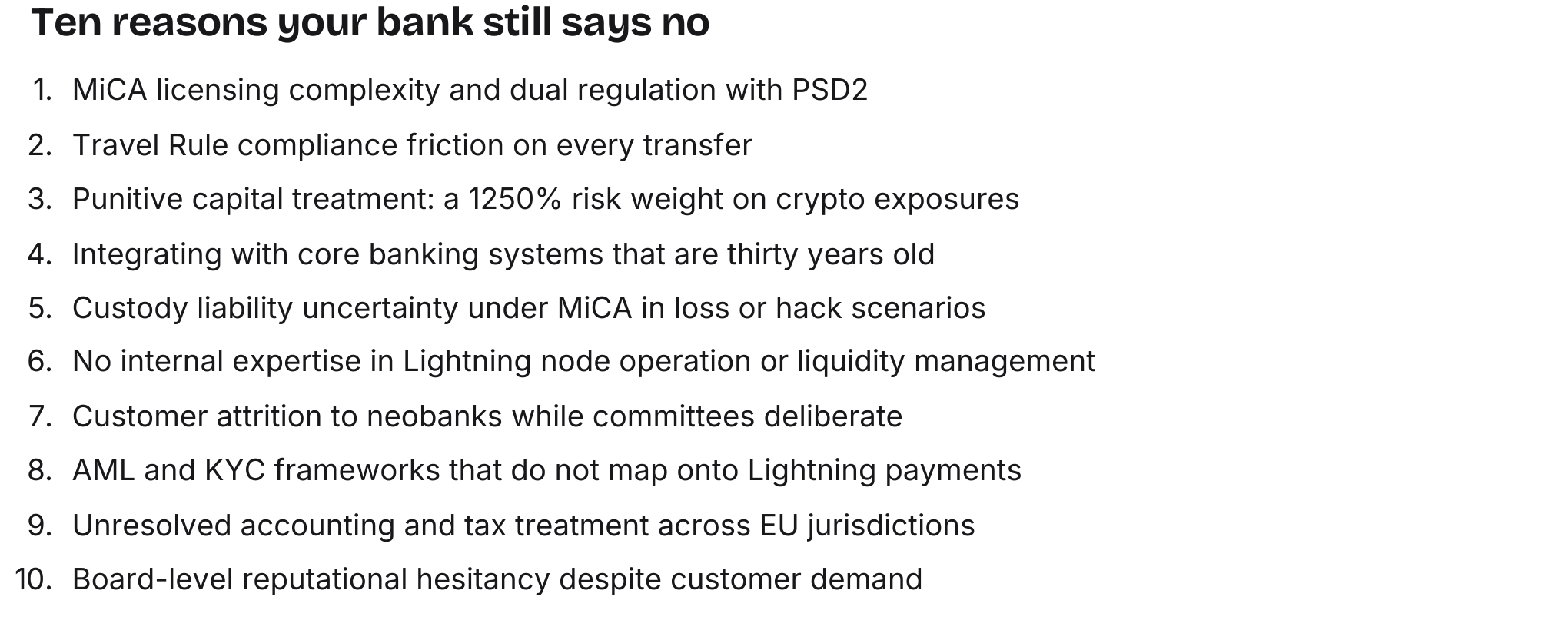
European Bitcoin Business Report, Issue 01, Section 5 — Banking.
Read that as a cost sheet rather than a set of objections. Every line represents a real expense in somebody's budget: monitoring, reporting, integration against core systems built decades ago, specialist staff, and legal uncertainty priced conservatively.
B. Balance Sheet Holding vs. Product Distribution

European Bitcoin Business Report, Issue 01, Section 5. Sources: BlockStories, March 2026; Boerse Stuttgart Digital survey of 6,000 investors in Germany, Italy, Spain and France; ECB, July 2026.
Because of capital rules, major European banks are entering digital assets primarily as off-balance-sheet product distributors. Institutions like Deutsche Bank, BPCE, and Sparkassen are introducing crypto custody or trading features within their gated, proprietary apps. Sparkassen alone has announced trading to 50 million customers, and BPCE plans to reach 12 million.
However, offering a fee-generating, closed-loop trading product inside a bank app is fundamentally different from acting as an open payment rail for external, self-custodied wallet transfers. External payment flows create monitoring burdens, potential AML liabilities, and source-of-funds verification requirements without generating distribution margins for the bank.
This is why customer demand alone does not resolve the friction. Thirty-five per cent of European investors say they would switch banks for better access, and only 8 of the top 20 EU banks have live crypto services—most still in pilot. Intesa Sanpaolo, Italy's largest bank, holds 11 BTC: financially immaterial against a $129bn market capitalisation, but a meaningful signal about where European banking currently sits.
C. Why Exchange Payouts Create Payment Friction
When an individual liquidates Bitcoin through a standard centralized exchange to their personal bank account, the structure of the transaction itself creates avoidable administrative friction.
Shared corporate omnibus accounts. Centralized exchanges typically process fiat cash-outs using massive, shared corporate pool accounts. The incoming SEPA transfer originates from an IBAN registered in the exchange's corporate name rather than the individual customer's name. To the receiving bank, this presents as third-party funding: money arriving into your account from a legal entity that is not you. Third-party funding is a long-established AML risk indicator, and it is assessed independently of anything to do with Bitcoin.
Counterparty IBAN mapping. Receiving banks maintain internal counterparty lists that map IBAN ranges to known institutions. Where a range is associated with a crypto exchange, inbound transfers can be categorised as sector-related before any human review takes place.
Name-matching as an emerging norm. Mandatory Verification of Payee (VoP) rules took effect across euro-area PSPs on 9 October 2025 under Regulation (EU) 2024/886, requiring a pre-payment check of the beneficiary's name against the account identifier. VoP is a payee-side control and is not itself the trigger for exchange payouts, but it reflects the broader direction of European payments: names and account identifiers are increasingly expected to line up, and structures where they do not attract more scrutiny over time.
D. Asymmetric Risk and "Anti-Tipping-Off" Rules
Transaction monitoring engines deployed by European banks utilize multi-hop blockchain analytics. If a coin interacted with an unhosted wallet, mixer, or flagged entity several hops prior, compliance algorithms generate an alert.
For a bank compliance department, the risk calculation is heavily skewed: processing an illicit transfer can lead to catastrophic regulatory fines, whereas reviewing or closing a customer's account costs the bank very little. Furthermore, under European AML directives (AMLD), banks are legally prohibited from disclosing the specific reason for an account review or closure—a restriction known as the "anti-tipping-off" rule that often leaves customers without explicit feedback.
3. What MiCA Changes: Authorization and Consolidation
The full enforcement of the European Union's Markets in Crypto-Assets (MiCA) regulation has established a single rulebook across the European Economic Area (EEA).
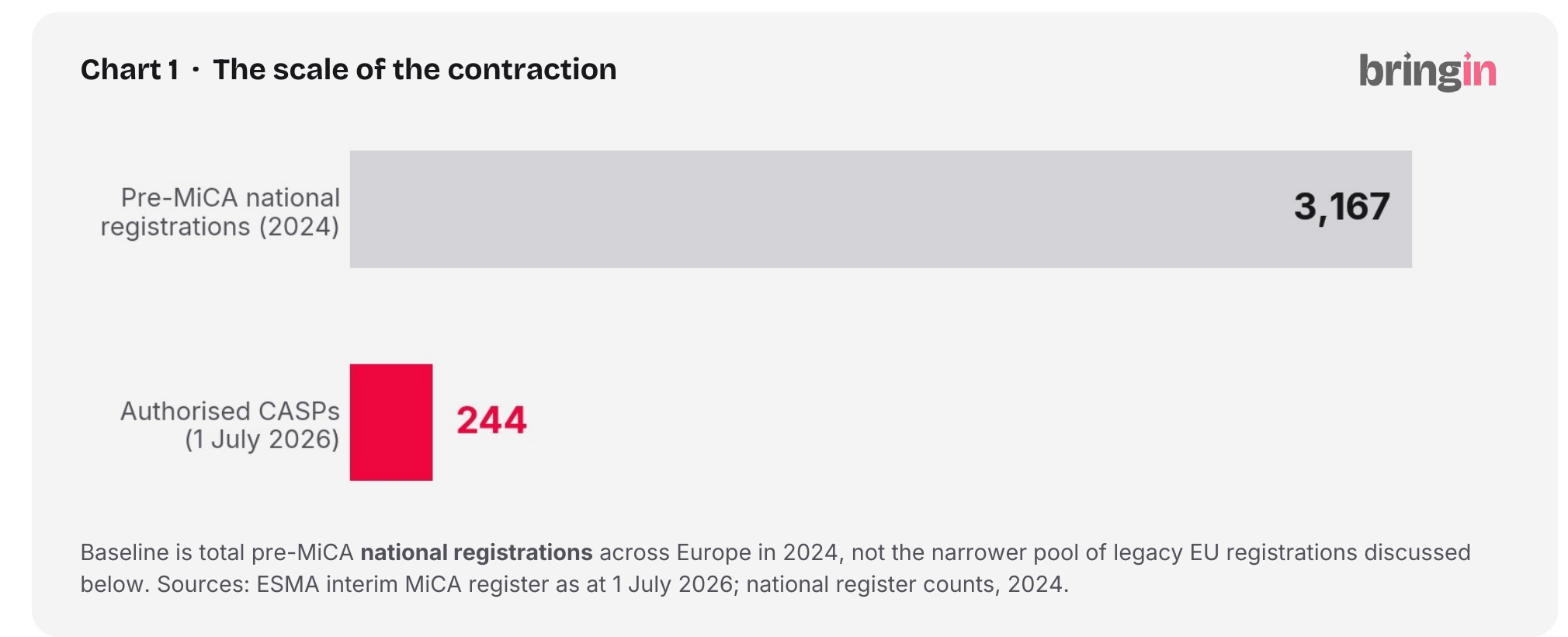
European Bitcoin Business Report, Issue 01, Section 1 — The Reset. Sources: ESMA interim MiCA register as at 1 July 2026; national register counts, 2024.
Following the expiration of MiCA's transitional grandfathering period on 1 July 2026, providing crypto-asset services in the EU without formal MiCA authorization became a breach of EU law.
Public comparisons between legacy national registries and post-transition registers reveal a substantial consolidation:
- Before MiCA, approximately 3,167 firms held various national crypto registrations across Europe (a number that included many dormant shells or lightweight local filings).
- Today, around 244 authorized Crypto-Asset Service Providers (CASPs) are listed on the ESMA register.
Simultaneously, DAC8 tax transparency rules (effective 1 January 2026) require regulated CASPs to collect user identity and transaction data for automatic cross-border exchange among EU tax authorities, with initial automated reporting scheduled for 30 September 2027.
The Responsibility of Self-Custody
By raising compliance standards for centralized intermediaries, MiCA and DAC8 have ironically reinforced the importance of self-custody. However, managing private keys requires absolute personal responsibility.
In traditional banking, lost credentials can be recovered and fraudulent charges disputed. In self-custody, there are no chargebacks, no support helplines, and no central bailouts. Self-custody offers true financial liberty, but only to those who maintain rigorous operational security over their seed phrases and hardware devices (yes even that isn’t fully fool proof as we saw during the recent Coldcard hack).
4. The Personal Virtual IBAN Model: Improving Payment Legibility
To address the information mismatch associated with corporate pool payouts, Bringin engineered an architecture centered on dedicated Virtual IBANs (vIBANs).
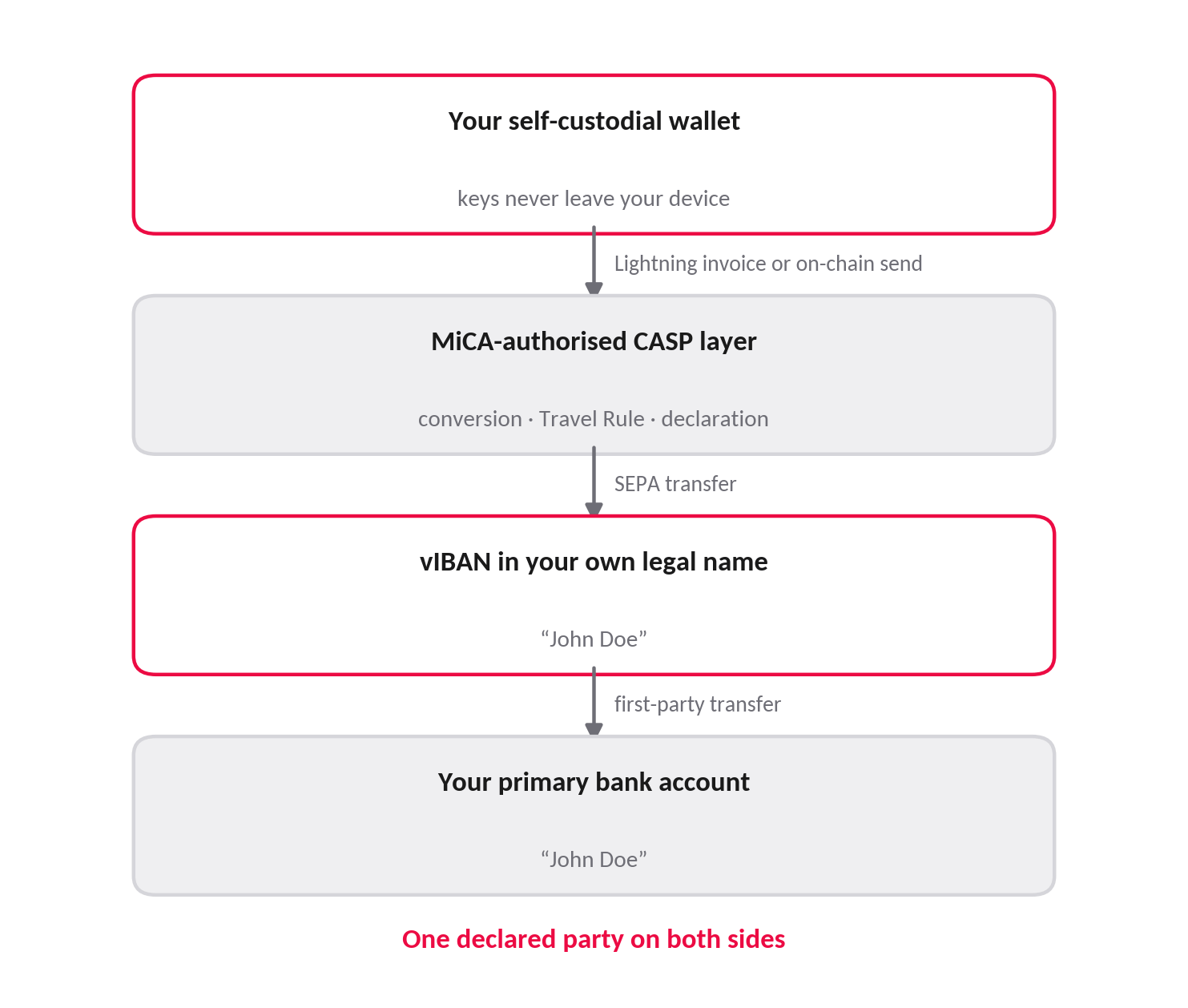
A. First-Party Payment Presentation
Instead of routing Euro payouts through a shared corporate exchange pool, Bringin provisions a dedicated European Virtual IBAN issued in the customer's legal name.
When a user liquidates Bitcoin via Bringin, the Euro transfer is sent from their assigned vIBAN. To the receiving bank, the incoming SEPA transfer is presented as an internal transfer between two accounts associated with the exact same individual (e.g., John Doe sending funds to John Doe). There is no third party in the payment chain, which removes the third-party funding pattern described above.
Central Trust Signal: This structure does not make a transaction invisible or exempt from compliance checks. Rather, it gives the payment a clearer first-party structure and helps reduce avoidable ambiguity about who is sending the funds.
B. Regulatory Infrastructure
Bringin operates as a software technology interface. The underlying payment and account services are provided through regulated infrastructure partners (vIBANs issued by OpenPayd, a licensed Electronic Money Institution), while crypto-asset conversion services are delivered via Lightspark Payments Europe AS, a MiCA-authorized CASP.
This raises a fair question: if banking Bitcoin carries the risks described in Section 2, how does an EMI absorb them?
It does not absorb them—it never takes them on. An Electronic Money Institution is not a credit institution, and it holds euros rather than Bitcoin, so the 1,250% risk weight has nothing to attach to. Safeguarded e-money cannot be lent out, so there is no funding or liquidity risk from balances that may leave tomorrow. And the crypto-facing obligations—conversion, Travel Rule, wallet ownership verification—sit with the authorized CASP rather than the EMI.
Each party in the chain carries only the risk it is licensed, staffed, and priced for. That is precisely what a single bank cannot do when it attempts to be all three at once.
5. Why Lightning Matters: Privacy Uncoupling and Instant Card Rails
In addition to Virtual IBAN off-ramps, Bringin utilizes the Lightning Network to provide fast, granular spending capabilities.
A. Reducing Broader Wallet History Exposure
When liquidating funds directly on-chain from a primary cold storage wallet to a centralized exchange, blockchain analytics can link the user's real-world identity to their historical on-chain cluster balance.
By routing smaller off-ramps over the Lightning Network, Bringin only sees the specific Lightning invoice paid at the moment of liquidation. This helps reduce the unnecessary exposure of a user's broader, long-term on-chain wallet history while fulfilling necessary compliance requirements for the specific transaction.
B. Instant Top-Ups and Global Card Spending
15-Second Card Top-Ups: Users can link a dedicated Bringin Lightning address to virtual or physical Visa debit cards. Paying a Lightning invoice from any self-custodial wallet (such as Phoenix) converts satoshis into spendable Euros on the card in ~15 seconds.
Flat 1% Conversion Fee & Zero Forex Markup: Bringin charges a flat 1% conversion fee. Unlike traditional bank cards that add 2% to 4% foreign exchange surcharges, Bringin charges zero foreign exchange markup, allowing European travelers to spend satoshis globally at standard Visa market rates.
Nodeless Self-Custody Option: For users who prefer not to manage Lightning channels manually, Bringin integrates a nodeless self-custodial wallet inside its app using the Breez SDK on Liquid (LBTC) with automated Boltz swaps.
6. For Merchants and Businesses: Bringin Business
The friction associated with crypto payment processing also impacts European commercial enterprises.
Under the EU Transfer of Funds Regulation (TFR / Travel Rule), accepting third-party customer crypto payments directly into a regulated corporate bank account can trigger counterparty identification requirements on every buyer—creating impractical KYC friction for buying a coffee or paying an online invoice.

European Bitcoin Business Report, Issue 01, Section 7 — Payments.
Bringin Business addresses this operational challenge by separating customer checkout from banking rails:
Wallet-to-Wallet Customer Checkout: Customers pay over the Lightning Network directly into a self-custodial wallet controlled by the merchant. Because peer-to-peer self-custodial transfers sit outside Travel Rule scope, buyers complete checkout without undergoing identity checks at the point of sale.
First-Party Corporate vIBAN Sweep: The merchant sweeps accumulated Bitcoin into their dedicated corporate vIBAN in their company name. Because this sweep is a first-party transfer between accounts owned by the same legal entity, it provides a clean, structured transaction record for corporate accounting, VAT reporting, and Travel Rule compliance.
Enterprise POS Integration: Through partnerships with POS providers like Opago (an SAP Open Ecosystem Partner), Bringin Business enables Lightning payment acceptance directly inside SAP Customer Checkout and standard European payment terminals.
7. What This Model Does Not Do
Three limitations are worth stating plainly, because a structure that is oversold fails the first time somebody tests it.
Safeguarded e-money is not a guaranteed deposit. Funds held at an Electronic Money Institution are segregated and cannot be lent out, which is a genuine protection. It is not the same mechanism as the €100,000 Deposit Guarantee Scheme that applies to a bank account. Different protection, worth knowing which one you hold.
The risk moves up the chain rather than disappearing. Every EMI safeguards its euros at a credit institution somewhere. If that institution changes its policy, everything downstream is affected at once.
This isn't a way to hide anything or an exemption from AML law and the bank might still ask for transaction details and source of funds especially for higher amounts.
IBAN-range recognition is a fact about today, not a permanent property. A first-party structure works in part because the issuing institution is not itself a crypto business. That is a description of current market conditions rather than a guarantee about future ones.
However, this approach reduces the risk of debanking and bank blockage significantly, as witnessed by hundreds of bitcoiners already using Bringin.
8. A Pragmatic Conclusion
European financial institutions operate within a strict risk and compliance framework. When Bitcoin-related transactions sit near the conservative end of a bank's risk appetite, the result is often increased scrutiny, payment holds, or account reviews. This does not mean Bitcoin users are doing anything wrong; it means traditional payment paths were not built to interpret decentralized source-of-funds history.
The practical answer is not to hide Bitcoin activity from banks, but to make the transaction structure clearer and more legible.
Bringin bridges self-custody with regulated European payment infrastructure through dedicated vIBANs, Lightning rails, and non-custodial wallets. The customer maintains control over their Bitcoin until they choose to convert it, while the resulting Euro transfer is associated with an account in their own name.
While this does not guarantee that a bank will never request documentation or review a payment, it accomplishes something far more practical: it reduces avoidable payment ambiguity and provides a transparent, compliant bridge for living on a Bitcoin standard in Europe.
Join the conversation
We are running a community call on Tuesday, 15 September to go through the Debanking question in detail—the mechanics behind it and the practical steps that reduce avoidable friction. Most of it will be questions from the people on the call.
If you've had a payment held, an account closed, or faced friction while offramping from bitcoin - bring your question to the call.
Register for the community call →
