

For businesses accepting Bitcoin in Europe, payments have become harder to navigate. Since the MiCA transitional period closed on 1 July 2026, every provider serving EU clients must be fully authorised, and each must apply the EU Travel Rule: collecting and transmitting specified information on the crypto-asset transfers it handles.
This article explains what the rule requires, where it creates friction for businesses, and how Bringin Business brings euro banking and Bitcoin self-custody together to keep accepting Bitcoin simple.
For most of Bitcoin's history in Europe, accepting it as a business was a technical question: which wallet, which payment tool, whether to run a Lightning node. Since this summer it has become a regulatory question as well.
The Travel Rule was written for intermediaries, not for shops, consultants or online stores. Depending on how a business receives payments, though, some of its friction reaches the merchant and the customer standing at the counter. At the Bringin Business launch call recently, our founder Prashanth Chandrashekar described it in one line: imagine buying a loaf of bread at a bakery and being asked for your name and where you live.
What the Travel Rule is
The Travel Rule is not a crypto invention. It began as a banking rule: when a bank sends a wire, information about the sender and the recipient travels with the money, so that investigators can follow a payment across several institutions without losing the trail. The Financial Action Task Force (FATF) made it part of its global standards as Recommendation 16, and in June 2019 extended it to virtual assets.
FATF does not make law. It sets standards, and each country decides how to legislate them. In the EU, that legislation is Regulation (EU) 2023/1113, the Transfer of Funds Regulation (TFR), which has applied to crypto-asset transfers since 30 December 2024. The European Banking Authority's Travel Rule Guidelines (EBA/GL/2024/11) set out how providers are expected to apply it in practice.
The rule binds providers, not people. Exchanges, custodial wallets, brokers and crypto payment processors, known in EU law as Crypto-Asset Service Providers or CASPs, must attach information identifying the sender and the recipient to the transfers they send, and check it on the transfers they receive.
This information moves alongside the transaction, through separate messaging systems between providers. None of it is written to the blockchain, and records are kept for five years.
Two numbers cause most of the confusion around the rule.
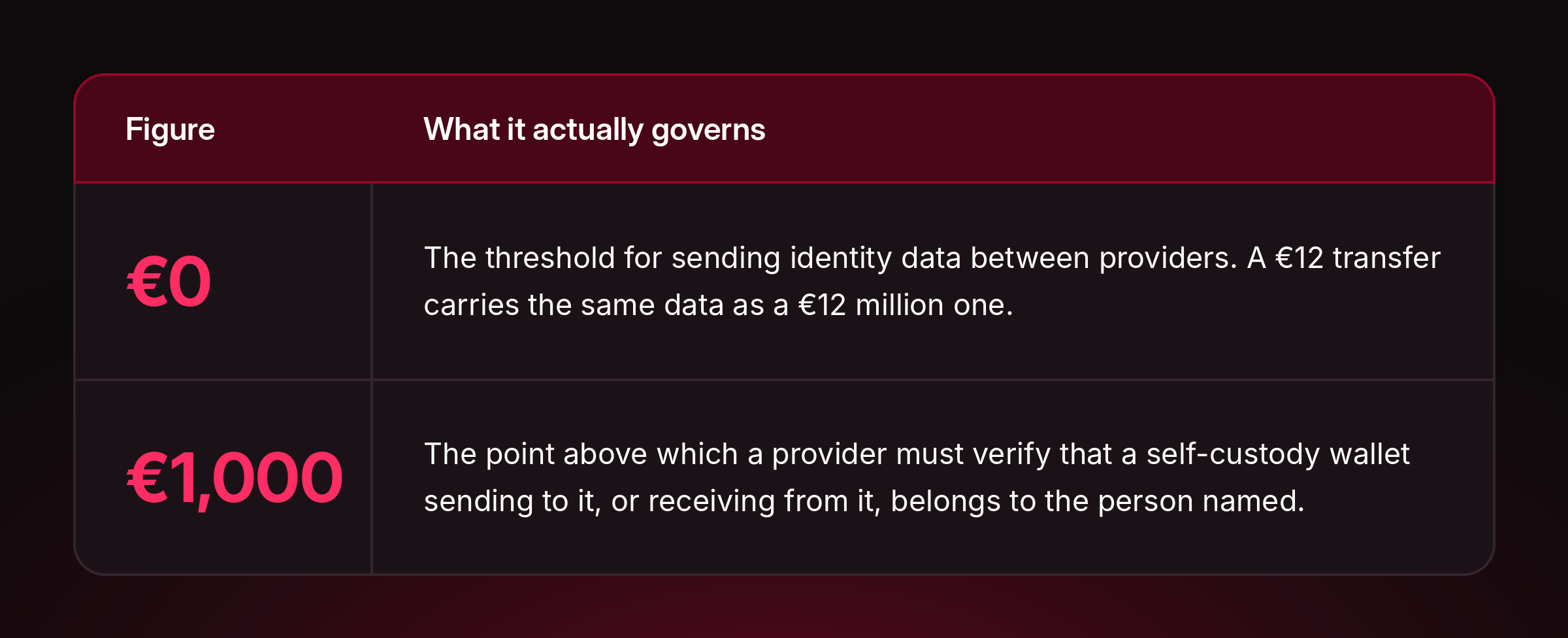
The zero threshold makes the EU's version the strictest implementation of the Travel Rule anywhere. The €1,000 figure is often quoted as the threshold, but it governs a separate check: above it, the provider has to take adequate measures to confirm who owns the wallet, usually through a small test transaction (a "Satoshi test") or a signed message.
What the rule does not reach matters just as much. Outside its scope are:
- Transfers between two self-custody wallets, with no provider involved.
- Businesses that accept Bitcoin for their goods or services, as long as they don't hold or move crypto on behalf of others.
The Travel Rule governs the intermediaries. That is why, for a business, the choice of intermediary ends up deciding how much of the rule it feels.
Key takeaway: The Travel Rule applies to providers, not to merchants or individuals. In the EU it covers every transfer between providers, whatever the amount, and adds a wallet ownership check above €1,000 when self-custody is involved.
What changed with MiCA?
MiCA and the TFR are often mentioned in the same breath, but they do different jobs:
- MiCA decides who is allowed to offer crypto-asset services in the EU.
- The TFR governs what has to happen on every transfer those providers handle.
A provider has to satisfy both.
Until this summer, many European businesses accepted Bitcoin through providers operating under national registrations and transitional arrangements that varied from one member state to the next. That period closed on 1 July 2026. A provider without a granted MiCA authorisation can no longer serve EU clients, and filing an application no longer counts. Authorised providers face the same anti-money laundering requirements as banks. The Travel Rule itself has applied since December 2024; what has changed is that every provider is now supervised for it.
For a business accepting Bitcoin, two things follow:
- Its own obligations have barely changed. A merchant taking payment for goods or services is not a CASP.
- Its provider's obligations have, and their effects can pass through. If customer payments arrive in an account at an exchange or another custodial service, that provider is required to obtain information about the sender, and to check the information it receives from other providers before making funds available.
Stablecoins are no exception. MiCA gave euro and dollar stablecoins their own regime for issuers, but a USDC payment between two providers carries exactly the same Travel Rule data as a Bitcoin payment. Changing the asset does not change the paperwork.
Key takeaway: Since 1 July 2026, every provider serving EU clients must be MiCA-authorised and is supervised for the Travel Rule. A merchant's own obligations are largely unchanged, but their provider's are not, and that applies to Bitcoin and stablecoins alike.
Why custodial accounts make accepting Bitcoin cumbersome?
Most businesses that accept Bitcoin today receive it into an account whose keys they do not hold: an exchange account, a custodial Lightning wallet, or a payment processor that holds funds before paying them out. Each of these is a CASP, and each has to apply the Travel Rule to the transfers it receives on the business's behalf. How that plays out varies by provider, but the friction tends to show up in three places.
Customers can be asked who they are. When a customer pays from their own wallet into a merchant's custodial account, the merchant's provider is required to obtain information about the sender. Depending on the provider, that can mean asking the customer for their name, country of residence or more, with no minimum amount. For a large B2B invoice, where the business already knows its client, this is manageable. For a café, a shop or an online store it is much harder, and it is the bakery problem Prashanth described. A widely shared case this year made the same point from the other side: someone received a zap to a custodial Lightning address and was reportedly asked to declare who had sent it.
Larger payments and Lightning can hit limits. Above €1,000 from a self-custody wallet, the provider must assess whether that wallet belongs to the person named. A Satoshi test or a signed message is reasonable when a customer is moving their own coins. At a checkout it is impractical, and some providers respond with limits or by declining such payments. Lightning runs into the same limit. The standard Travel Rule messaging model is built around an on-chain transaction ID and a destination address, which a Lightning payment doesn't produce, and many compliance tools don't support it. As a result, many custodial providers don't send Travel Rule information with Lightning payments. The receiving provider then treats the payment as coming from a self-custody wallet, which caps it at €1,000 unless the sender goes through additional verification.
Payments can be held. A provider that receives a transfer without the required information may hold it, request the missing data, or return it. Industry data suggests this has become more common: Notabene's annual survey of virtual asset service providers recorded a 431% year-on-year increase in providers blocking withdrawals until beneficiary details are confirmed, with around one in five returning deposits when sender data doesn't arrive. For the merchant, it can look like money that has left the customer's wallet but hasn't arrived: a sale that isn't settled, with little control over when it will be.
Strictly, none of this is the merchant's legal obligation. It sits with the provider, but the merchant and the customer are the ones who feel it. That makes it less a question of paperwork than of how payments are received in the first place.
Key takeaway: Receiving into a custodial account can mean asking customers for personal details, running into limits on larger or Lightning payments, and waiting on held funds. The obligation sits with the provider; the friction is felt by the merchant.
How Bringin Business approaches it
Bringin Business brings euro banking and Bitcoin self-custody together in one account, so a business can accept Bitcoin, manage it, and convert to euros when it needs to, without assembling a stack of separate tools. The Travel Rule is why that design matters now. The rule applies where funds cross between a regulated provider and the outside world, while transfers between self-custody wallets with no provider involved fall outside its scope. Keeping a business's Bitcoin in self-custody, with euro banking beside it, is meant to keep the regulated steps to the points where they are straightforward to handle.
The account is built in two layers.
A euro account in your company's name, available today. Each business gets a dedicated IBAN in its own name, with an exchange beside it, so Bitcoin can be sold into euros and sent to the company's bank by SEPA or SEPA Instant. Because the money moves between two accounts the business owns, its bank sees a first-party transfer rather than a payout from a crypto exchange. This structure can help reduce the banking friction associated with third-party crypto-exchange payouts.
Operational Wallets. Businesses that hold Bitcoin tend to run into the same operational problems: one person holding the keys, no separation between the treasury and day-to-day spending, and no clean way to give the team or an accountant the access they need without handing over control. Operational Wallets are built for exactly that, with operations and security designed in from the start rather than added later.
Every Operational Wallet is built on Turnkey. Keys are generated and stored inside Turnkey's secure enclaves, isolated hardware environments in the cloud that work like a hardware wallet: the keys never leave the enclave, and they can only be used to sign. Every signature has to be authorised by you, using your passkey. On top of that, businesses can:
- Hold and send Bitcoin on-chain, or pay instantly over Lightning through Spark.
- Keep the treasury separate from day-to-day operational wallets, with multiple approvals required before treasury funds move.
- Set clear policies for who can do what, so an accountant can see balances and export statements without being able to move a single sat.
The link between the two layers is where the compliance work is done. When funds move between your IBAN and your self-custody wallet:
- The same business is on both sides of the transfer, so the sender and recipient are already known.
- Ownership of the wallet can be proven cryptographically, rather than tested with a Satoshi transfer.
- The information the rule requires can be handled in the background, without forms or test transactions.
To the user, it is designed to feel like moving funds within a single account.
In practice: from payment to euros
Accepting. A customer paying from their own wallet to your self-custody wallet makes a wallet-to-wallet transfer, with no provider in between. That means:
- No intermediary asking your customer for their details.
- No payment held for checks before it reaches you.
- No minimum amount: a single sat, a tip or a zap from Nostr arrives the same way.
As Prashanth put it on the call, nothing sits between the moment the customer presses send and the moment the funds land in your self-custody.
If a customer pays from an exchange account instead, their provider applies its own checks on its side of the transfer.
Managing. Bitcoin you keep stays in self-custody, with access shared across the team according to the policies you set, and the treasury held separately from day-to-day funds.
Converting. When you need euros, for an invoice, a supplier or payroll, you move Bitcoin into your Bringin account and sell it. The regulated part of the journey happens between two accounts in your name, and the euros reach your bank as a transfer from yourself.
Key takeaway: Bringin Business keeps Bitcoin in self-custody and euros in an account in your own name. Regulated steps happen between two accounts you own, so customers can pay from their own wallets without being asked who they are. The euro account is live today; Operational Wallets are rolling out now.
Working with the tools merchants already use
Most merchants don't take Bitcoin from a wallet screen. They take it through a checkout, a point-of-sale app or an invoice. Bringin Business connects with BTCPay Server and Coinsnap, two checkout tools many European merchants already use, so customers can keep paying the way they do today. We also work with vetted payment tools such as Zaprite, aiming for native integrations so that statements carry what an accountant needs.
The broader aim is a shorter stack. A typical business runs on a bank, a card processor and an accounting tool. Adding Bitcoin has usually meant adding:
- a wallet and an exchange
- a Bitcoin payment tool and a Lightning node
- a crypto tax tool, and scripts to reconcile it all
Bringin Business is designed to bring the wallet, euro banking, the exchange and Lightning into one account, next to the tools a business already uses, with the wallet layer completing that picture as it rolls out.
One of our early users described the problem it solves:
"Accepting payments from customers in Bitcoin comes easy. The trouble with regular banks comes when you need an off-ramp solution to also use the earned BTC. As a business which receives payments and mining rewards in Bitcoin but also needs to pay suppliers in both worlds, fiat and Bitcoin, I was waiting for a solution like Bringin. It lets me focus on my business and not on compliance questionnaires from banks."
- 20Plus1
Where this leaves European businesses
The Travel Rule is not going away. FATF revised Recommendation 16 in June 2025, countries have until the end of 2030 to implement it, and thresholds around the world have only moved in one direction. Businesses that want to accept Bitcoin in Europe need a setup that works with the rule rather than around it.
Bringin Business is built for that: accepting Bitcoin with less friction, moving between Bitcoin and euros through an account in your own name, and managing Bitcoin the way a business needs to, with self-custody, shared access and a separate treasury.
Bringin Business is in public beta, with access opening to businesses by invitation.
Request Invite Access
----------------------------------------------------------------------------------------
This article is general information, not legal advice. Regulatory requirements vary by member state and change over time.
